Matthew Lowder, associate professor of psychology, along with Gwynna Ryan '21, published "Retrieval Interference in the Processing of Relative Clauses: Evidence from the Visual-World Paradigm" in Language, Cognition and Neuroscience.
Join us as Rebecca M. M. Hicke, PhD candidate at Cornell, presents a talk, How to Read Books with AI: AI and Narrative Analysis. Rebecca’s research interests lie in computational humanities, natural language processing, and cultural analytics. Specifically, I explore how large language models (LLMs) can be use for complex textual, particularly literary, analysis tasks.
March 24 @ 4:30 pm in Jepson Hall 118
Data Visualization Grant-Funding
Statistics professor Taylor Arnold and digital humanities professor Lauren Tilton recently received grant funding for two data science projects. They received a $485,000 grant from the Mellon Foundation for their Distant Viewing Toolkit project, an open-source technology for the computational analysis of visual culture. Arnold and Tilton have also received a nearly $325K grant from the National Endowment for the Humanities to support a project to build open-source software for collecting and analyzing digital images.
Faculty Highlights
Matthew Lowder, associate professor of psychology, published "Dominance Norms for 274 Korean Homonyms" in the Journal of Psycholinguistic Research.
Yucong Jiang was promoted to associate professor of computer science. Her current research focuses on building software to analyze music-related data, especially performance data. Her latest project is aimed at visualizing technical aspects of an instrumental performance to provide multifaceted feedback to the player.
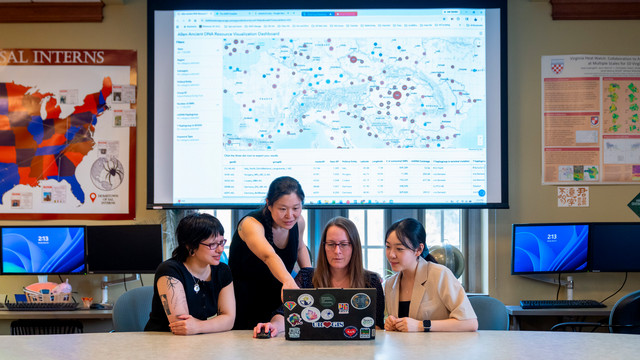
Melinda Yang was promoted to associate professor of biology. Her research focuses on using and developing computational population genetic tools to study the evolutionary history and genetic variation of species, especially humans, by analyzing both ancient and present-day genomes. Her work combines assessing the robustness of these tools with uncovering demographic relationships, with a particular emphasis on ancient human populations.